
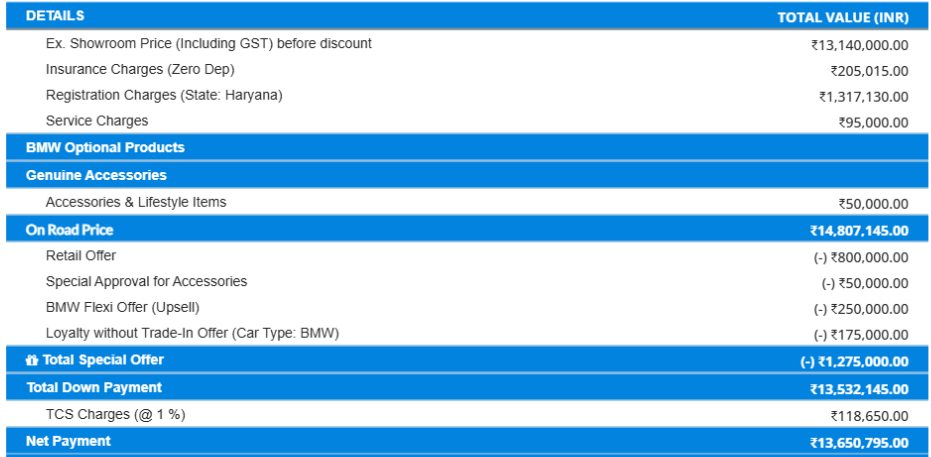
One of the biggest surprises for first-time luxury car buyers in India is discovering that the final amount payable is significantly higher than the advertised ex-showroom price. A luxury sedan advertised at Rs 65 lakh may ultimately cost Rs 75 lakh to Rs 85 lakh on-road, while a luxury SUV priced at Rs 1 crore ex-showroom can easily cross Rs 1.15 crore to Rs 1.30 crore after taxes, registration, insurance, and statutory charges.
Understanding the luxury car on-road price calculation in India is essential before making a purchase decision. Whether you are buying as an individual or through a company, taxes and compliance requirements can materially affect the total cost.
This guide explains:
- How luxury car on-road prices are calculated
- Major components of luxury car taxes India
- Registration and road tax implications
- TCS (Tax Collected at Source) rules
- Individual vs company ownership considerations
- GST treatment and Input Tax Credit (ITC)
- Practical ways to reduce ownership costs legally
Disclaimer: Tax laws, road tax rates, registration fees, insurance premiums, and TCS provisions may change. Buyers should verify current rates with the relevant State Transport Department, Income Tax Department, GST authorities, insurers, and dealers before purchase.
1. What Is Ex-Showroom Price?
The ex-showroom price is the price at which a vehicle is sold by the dealer before registration, insurance, road tax, and other ownership-related charges.
It generally includes:
- Manufacturer base price
- GST
- Dealer margin
- Logistics and distribution costs
For luxury vehicles, the applicable GST rate constitutes a substantial portion of the ex-showroom price.
Components of Ex-Showroom Pricing
| Component | Included in Ex-Showroom? |
| Manufacturer base price | Yes |
| GST | Yes |
| Dealer margin | Yes |
| Registration fee | No |
| Road tax | No |
| Insurance | No |
| FASTag | No |
| TCS | No |
Why Ex-Showroom Is Not the Final Price?
Luxury car buyers must additionally pay state road tax, registration fees, insurance, TCS, and opt for accessories or extended warranties. This explains why the luxury car on-road price in India is often 10 percent to 25 percent higher than the ex-showroom figure.
Also Read: New Car Buying Guide: How to Buy Luxury Car in India
2. Components of Luxury Car On-Road Price in India
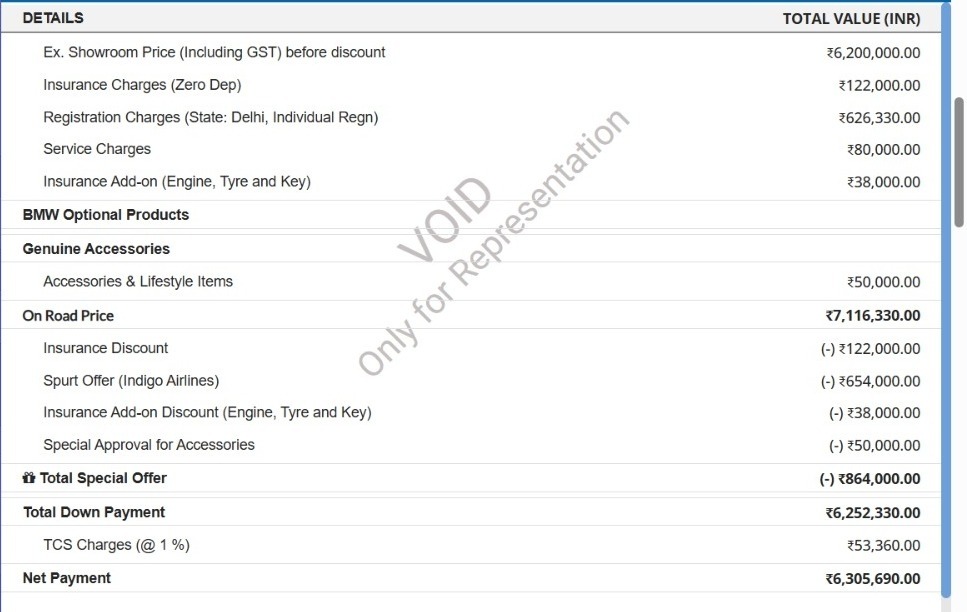
Typical On-Road Cost Structure
| Cost Component | Mandatory? | Typical Range | Notes |
| 1. Ex-showroom price | Yes | Vehicle dependent | Base transaction value |
| 2. Road tax | Yes | 8 percent to 20 percent plus | State-specific |
| 3. Registration charges | Yes | Rs 5,000 to Rs 50,000 plus | Depends on state and vehicle |
| 4. FASTag | Yes | Rs 500 to Rs 1,000 | Mandatory for most registrations |
| 5. Insurance | Yes | 1.5 percent to 4 percent of value | Varies by insurer |
| 6. TCS | Yes | 1 percent | Subject to Income Tax provisions |
| 7. Extended warranty | Optional | Rs 50,000 to Rs 5 lakh | Manufacturer dependent |
| 8. Accessories | Optional | Rs 25,000 to Rs 10 lakh plus | Customer preference |
3. Road Tax and Registration Charges
One of the largest contributors to luxury car registration cost is state road tax. India does not have a uniform road tax structure. Each state imposes its own rates under its motor vehicle taxation laws.
Luxury vehicles generally attract higher tax slabs because taxes are often linked to vehicle cost, engine capacity, fuel type, and vehicle category.
State Comparison
- Delhi: Cost-based slabs where high-value vehicles attract higher tax rates.
- Maharashtra: Calculated as a percentage of the vehicle cost.
- Karnataka: Known to have among the highest road tax structures in India.
- Tamil Nadu: Higher rates applied for vehicles above specified value thresholds.
Impact on Luxury Vehicles
A vehicle costing Rs 1 crore may incur Rs 10 lakh in road tax in one state, while the same vehicle could incur Rs 18 lakh to Rs 20 lakh in another state. This creates substantial differences in luxury car registration fees across India. Actual rates should always be confirmed with the respective transport authority before purchase.
4. Insurance Costs for Luxury Cars
Insurance is another major component of luxury car ownership cost in India.
Recommended Coverage
- Third-Party Insurance: Mandatory under Indian law.
- Comprehensive Insurance: Covers own damage, theft, natural disasters, and accidents.
- Zero Depreciation Cover: Especially useful for luxury vehicles with expensive replacement parts.
- Engine Protection: Recommended for high-performance cars, turbocharged vehicles, and buyers in flood-prone cities.
- Return-to-Invoice Cover: Provides compensation close to the invoice value in total loss situations.
Estimated Annual Insurance Costs
- Vehicle Value Rs 50 lakh: Premium Rs 1 lakh to Rs 1.5 lakh
- Vehicle Value Rs 1 crore: Premium Rs 1.5 lakh to Rs 2.5 lakh
- Vehicle Value Rs 2 crore: Premium Rs 2.5 lakh to Rs 4.0 lakh
Actual premiums vary based on city, driver profile, claim history, chosen insurer, and selected coverage options.
5. Understanding TCS on Luxury Cars
One of the most misunderstood components of luxury car TCS in India is Tax Collected at Source. Under Section 206C(1F) of the Income-tax Act, sellers are required to collect TCS at 1 percent on eligible motor vehicle sales exceeding Rs 10 lakh.
Important Point: TCS is not an additional permanent tax burden. The amount collected appears in the buyer’s tax records and can be adjusted against income tax liability or claimed as a credit while filing the income tax return.
Example Calculations
- Car Costing Rs 80 Lakh: Vehicle value Rs 80,000,000 plus TCS at 1 percent (Rs 80,000) equals Rs 80,80,000 total payable.
- Car Costing Rs 1.2 Crore: Vehicle value Rs 1,20,000,000 plus TCS at 1 percent (Rs 1,20,000) equals Rs 1,21,20,000 total payable.
- Car Costing Rs 2 Crore: Vehicle value Rs 2,00,000,000 plus TCS at 1 percent (Rs 2,00,000) equals Rs 2,02,00,000 total payable.
6. Individual Purchase vs Company Purchase
A common question in the company purchase luxury car context is whether buying through a business reduces overall taxes. The answer depends heavily on usage, documentation, and specific tax treatment.
Comparison Overview
- Registration: Personal purchase registers in an individual’s name, while corporate purchase registers in the company name.
- Depreciation Benefit: Not available for tax purposes for individuals, but generally available for companies subject to tax rules.
- Business Expense Claims: Limited for individuals, but possible for companies if business use is established.
- Compliance Burden: Low for individuals, but higher for companies requiring detailed record keeping.
- Financing: Based on personal credit for individuals and corporate borrowing profiles for companies.
When Company Ownership May Help: This is suitable when the vehicle is genuinely used for business, the company has taxable profits, and proper accounting documentation is maintained.
When It May Not Help: This is not ideal if the vehicle is primarily for personal use, lacks business-use evidence, or if the corporate compliance costs outweigh the tax benefits.
7. GST Considerations for Luxury Cars
Understanding GST on luxury cars in India is critical, especially following the recent fiscal tax structure updates implemented in late 2025 and 2026.
GST Structure The Indian government has simplified the automobile tax structure by eliminating the compensation cess. Luxury passenger vehicles (engine capacity over 1500cc or length over 4000mm) now attract a flat GST rate of 40 percent, replacing the older system of 28 percent GST plus variable cess. Conversely, luxury electric vehicles (EVs) continue to benefit from a highly concessional GST rate of 5 percent.
Can GST Be Claimed Back? In most cases, Input Tax Credit (ITC) on passenger vehicles is blocked.
- ITC May Be Available For: Vehicle dealerships, passenger transportation businesses, driving schools, and certain other permitted uses.
- ITC Generally Not Available For: Personal luxury cars, director personal use, and employee transportation for non-eligible purposes.
8. Worked Examples: Luxury Car On-Road Price Calculation
The following examples are illustrative only. Actual figures vary by state, dealer, insurance provider, and registration jurisdiction.
Example 1: Luxury Sedan(e.g. Mercedes-Benz C-Class)
- Ex-showroom: Rs 65,00,000
- Road tax (estimated 12 percent): Rs 7,80,000
- Registration: Rs 50,000
- Insurance: Rs 1,50,000
- FASTag and misc: Rs 1,000
- TCS (1 percent): Rs 65,000
- Total On-Road Price: Rs 75,46,000
Example 2: Executive Luxury Sedan (e.g. BMW 5 Series)
- Ex-showroom: Rs 75,00,000
- Road tax (estimated 12 percent): Rs 9,00,000
- Registration: Rs 50,000
- Insurance: Rs 1,80,000
- FASTag and misc: Rs 1,000
- TCS (1 percent): Rs 75,000
- Total On-Road Price: Rs 87,06,000
Example 3: Premium SUV (e.g. Range Rover Velar)
- Ex-showroom: Rs 95,00,000
- Road tax (estimated 15 percent): Rs 14,25,000
- Registration: Rs 50,000
- Insurance: Rs 2,50,000
- FASTag and misc: Rs 1,000
- TCS (1 percent): Rs 95,000
- Total On-Road Price: Rs 1,13,21,000
9. Cost-Saving Strategies for Luxury Car Buyers
The goal should be legal tax efficiency, not tax avoidance.
- Compare Registration Costs: Where legally permissible, compare ownership costs across states where you genuinely reside or operate.
- Evaluate Corporate Ownership Carefully: A company purchase may provide depreciation benefits in certain situations.
- Optimize Insurance: Compare insurers, avoid unnecessary add-ons, and retain essential covers.
- Use Manufacturer Offers: Luxury brands frequently provide service packages, warranty extensions, and bundled insurance deals.
- Buy During Year-End Sales: March, quarter-end, and calendar-year-end discounts can be significant.
- Consider Certified Pre-Owned Vehicles: Many luxury manufacturers offer certified used vehicles with full warranty support.
- Compare Financing Options: Differences in interest rates can significantly affect total ownership cost.
Common Mistakes Buyers Make
- Ignoring TCS in initial budget calculations.
- Underestimating comprehensive insurance premiums.
- Forgetting annual maintenance and consumable costs.
- Assuming GST is always claimable for businesses.
- Looking only at advertised ex-showroom prices.
- Ignoring state-level registration tax differences.
- Not evaluating long-term depreciation implications.
- Failing to compare third-party financing offers independently.
Conclusion
Understanding the luxury car on-road price India calculation is essential before purchasing any premium vehicle. The difference between ex-showroom and on-road pricing can run into several lakhs of rupees due to road tax, registration, insurance, and TCS obligations. Whether you are evaluating luxury car taxes, estimating registration costs, assessing TCS applications, or deciding between individual and company ownership, a comprehensive cost analysis can prevent expensive surprises and help you make a financially informed purchase.
For high-value purchases above Rs 50 lakh, consulting a chartered accountant and reviewing state-specific transport regulations is strongly recommended before finalising the transaction. To stay updated on the latest financial implications of luxury vehicle ownership, SEO-driven market trends, and detailed cost analyses, follow Motozite for the most accurate and strategic automotive insights in India.
Frequently Asked Questions (FAQ)
1. How much tax is paid on luxury cars in India?
Following recent tax reforms, standard internal combustion luxury cars generally attract a flat GST rate of 40 percent with no compensation cess. Electric luxury vehicles attract 5 percent GST. Buyers additionally pay state road tax, registration charges, and other statutory fees.
2. Is TCS refundable?
TCS is generally adjustable against the buyer income tax liability and can be claimed as credit when filing the annual income tax return.
3. Can a company buy a luxury car and claim tax benefits?
Yes, subject to applicable tax laws, corporate depreciation provisions, and strict business-use requirements.
4. Is GST refundable on luxury vehicles?
Usually not for ordinary passenger vehicle purchases. Input Tax Credit is restricted except in highly specified business-use cases.
5. Why is the on-road price much higher than the ex-showroom price?
State road tax, RTO registration, comprehensive insurance, TCS, and other statutory charges significantly increase the final payable amount.
6. Which state has lower registration charges?
This changes periodically based on state transport budgets. Buyers should verify current rates with the relevant transport authority.
7. Does insurance vary by city?
Yes, Premiums vary based on the specific city risk profile, claims history, chosen insurer, and exact coverage selection.
8. What is the cheapest way to buy a luxury car legally?
Typically, the best approach involves negotiating direct dealer discounts, comparing multiple insurance providers, evaluating certified pre-owned options, considering genuine corporate ownership where appropriate, and purchasing during promotional transition periods.